

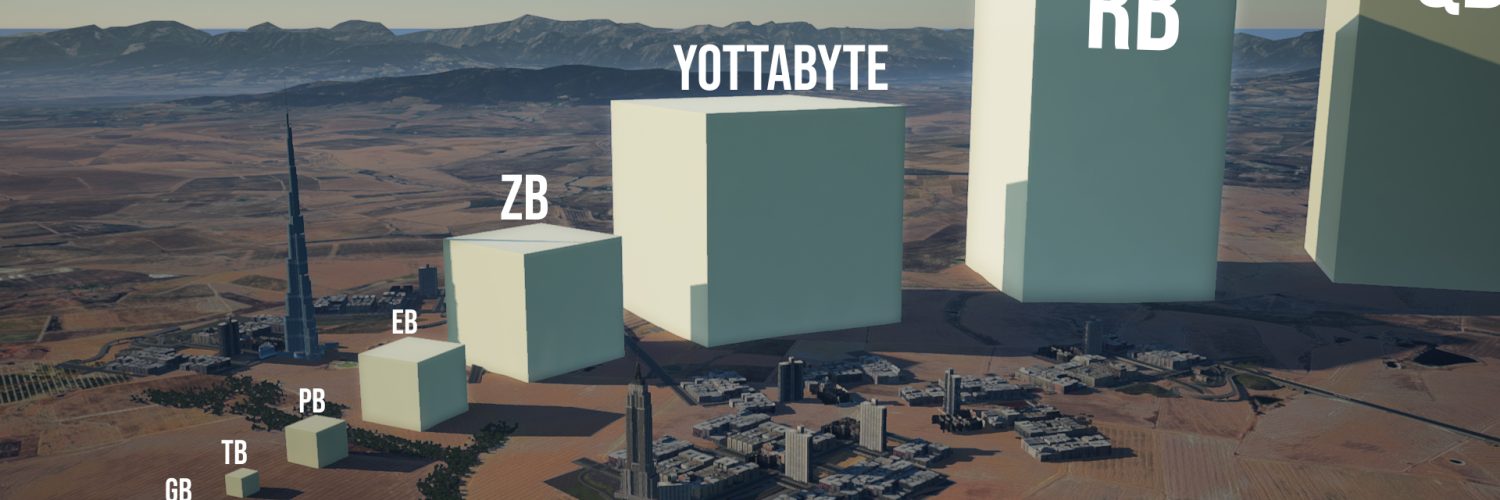
Understanding data sizes can be abstract when we only see numbers on a screen. In this data visualization, we bring those numbers into the physical world to answer a fascinating question: If a single byte were a tiny 1cm³ cube, how much space would the world’s most massive data sets occupy? We transition through kilobytes, megabytes, and terabytes, eventually reaching the staggering quettabyte, a unit so large it challenges our perception of volume. This step-by-step comparison reveals the ‘hidden’ physical footprint of our digital lives, providing a sense of scale that numbers alone simply cannot convey.
Here’s the crazy part: Your smartphone, the one in your pocket right now, holds more storage capacity than every computer on Earth combined during the entire 1980s.
What makes this comparison so striking is that we usually think of data as “weightless” or “invisible.” But data requires physical infrastructure, silicon, magnetic platters, and electricity. By assigning a physical volume of 1cm³ to a single byte, we can finally see the “invisible” weight of the internet. It turns a theoretical number into a tangible object, allowing us to ask: If we stacked all this up, how high would it reach? As we climb from the size of a sugar cube toward a quettabyte, the geometry becomes a skyscraper, then a mountain, and eventually, it outgrows our very atmosphere.
The reason this Big Data Factor visual 3D comparison is so satisfying to watch is that it solves a fundamental human problem: our brains aren’t wired to understand exponential growth. We can imagine 100 things or even 1,000, but once we reach a zettabyte (10²¹ bytes) or a quettabyte (10³⁰ bytes), the numbers just become “noise.” Seeing these units rendered in 3D, watching a tiny cube evolve into a massive monolith, gives us a “spatial gut-check.” It’s not just an education; it’s a perspective shift that makes the sheer scale of human knowledge and digital creation feel real.




Add comment